Real-Time WIP Reporting: 5 Reasons Subcontractors Ditch Spreadsheets
In construction finance, relying on month-end spreadsheets instead of real-time WIP reporting is like driving while looking exclusively in the rearview mirror. By the time your accounting team...
In construction finance, relying on month-end spreadsheets instead of real-time WIP reporting is like driving while looking exclusively in the rearview mirror. By the time your accounting team finishes reconciling exports, tracking down project managers for field updates, and piecing together billing statuses, a profitable job can quietly slip into margin erosion or a severe cash-flow crunch.
For decades, Work-in-Progress (WIP) reporting has been treated as a static, retrospective accounting exercise. Today, forward-thinking trade contractors are moving away from manual spreadsheets toward live project intelligence and construction billing platforms.
1. Eliminating Stale Data with Real-Time WIP Reporting
Most subcontractor finance teams spend days—sometimes weeks—pulling together month-end WIP reports. The manual workflow typically involves exporting numbers from an accounting system, chasing project managers via email or phone calls, and cross-referencing pay applications, unapproved change orders, and aging receivables.
Because manual reports take so long to assemble, the data is already outdated the moment it is finalized. Decisions regarding labor allocation, change order follow-ups, or aggressive collections get delayed until the next reporting cycle. Switching to real-time WIP reporting ensures your financial picture updates continuously as daily billing and collections work happens.
2. Triaging Project Risk in Seconds, Not Hours
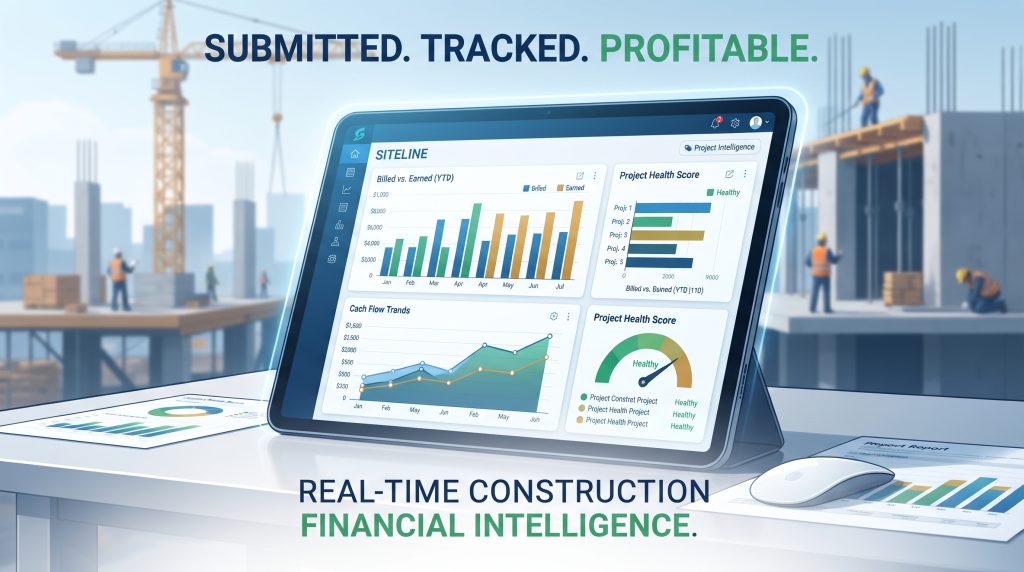
Instead of building a complex spreadsheet from scratch every 30 days, modern platforms roll up billing execution, collections activity, cash position, and change order exposure into a live, color-coded health score for every active job.
When finance leaders have immediate visibility across their entire project portfolio, they can spot warning signs before they turn into write-downs:
- Billed vs. Earned Accuracy: Instantly identify over-billed or under-billed jobs before they distort cash flow or profit projections.
- Live Cash Position and Gross Profit: Monitor real-time margin performance across jobs rather than discovering profit fade weeks after the fact.
- Unapproved Change Order Exposure: Keep pending scope changes front and center so project teams prioritize approvals before field costs outpace billings.
As Colton S., Accounting Manager at Cornerstone Forming, noted on the impact of centralized visibility: “Siteline gives us a complete and accurate picture of the status of every job at that moment… There’s no need to email; there’s no need to call.”
3. Aligning Project Managers and Accounting Teams
Traditional WIP processes often create friction between the field and the back office. Project managers focus on production schedules and field execution, while controllers and CFOs focus on cash flow, compliance, and risk. When both sides work from disconnected spreadsheets, leadership lacks a single source of truth.
Centralizing pay apps, change orders, and collections in one collaborative workspace bridges that gap. Project managers can review billing progress without digging through accounting software, and finance teams gain instant context on project milestones without sending endless follow-up emails.
4. Preventing Pay App Rejections and Lien Waiver Bottlenecks
A WIP report is only as reliable as the billing and collections workflows feeding into it. One of the most common causes of delayed subcontractor payments is missing documentation—especially lower-tier lien waivers and compliance forms.
When lien waivers are tracked manually in spreadsheets, missing paperwork frequently goes unnoticed until a general contractor rejects a pay application. Modern billing platforms automate lien waiver generation, send scheduled reminders to lower-tier vendors, and track collection status in real time—keeping pay apps moving and protecting cash flow.
5. Integrating With Your Existing ERP Without Disruption
One of the biggest hesitations construction finance teams have when adopting new software is disrupting their core accounting system. Effective operational tools do not replace your construction ERP; they integrate directly with it—keeping the ERP as your financial system of record while adding a live intelligence layer for day-to-day billing and collections.
Subcontractors have already billed over $14 billion across 250,000+ projects using connected billing workflows that sync seamlessly with their ERP. For growing trade contractors, real-time WIP reporting turns financial oversight from a stressful monthly fire drill into a daily competitive advantage.
Explore More Data & Construction Tech Insights
Looking to modernize your financial workflows and reporting stack? Check out our latest guides on construction data analytics and financial automation.
Datapoch helps contractors in the USA and Canada capture more leads, automate follow-up, and book more appointments" is a strong line. Adding a time-bound benefit would make it more specific, for example: "…book more appointments without hiring extra office staff.
Get Free Consultation" works. "Get My Free Lead Audit" usually converts better for contractors because it promises something concrete.
Get Free ConsultationFrequently Asked Questions
How can contractors get more leads from their website?
Add a fast response system, clear calls to action, an instant estimate tool, AI chat, and automated follow-up so no enquiry goes cold.
How fast should a contractor respond to a new lead?
As fast as possible. Homeowners often contact several contractors, and the first one to reply usually wins the appointment. Automation helps you reply within a minute, even after hours.
Does Datapoch work with contractors outside the USA?
Yes. Datapoch works with contractors in the USA and Canada and can set up lead capture, follow-up and booking automation for your business.