
AI-Powered Business Intelligence: From Data to Decisions
AI-Powered Business Intelligence: From Data to Decisions AI-powered business intelligence is changing how businesses understand their data, monitor performance, and […]
AI-Powered Business Intelligence: From Data to Decisions
AI-powered business intelligence is changing how businesses understand their data, monitor performance, and make informed decisions.
Businesses collect more data than ever before. Sales transactions, financial records, customer information, operational reports, and inventory data continuously generate valuable information.
However, having access to data does not necessarily mean understanding it.
Many businesses still depend on spreadsheets, manually prepared reports, and disconnected dashboards to understand their performance. Finding the right answer often requires exporting files, cleaning information, building formulas, and interpreting results manually.
AI-powered business intelligence makes this process more accessible by combining data analytics, automated KPI calculations, anomaly detection, and natural-language analysis.
At DataPoch, we are developing practical analytics solutions that help businesses move beyond static reporting toward faster, more accessible, and intelligent decision-making.
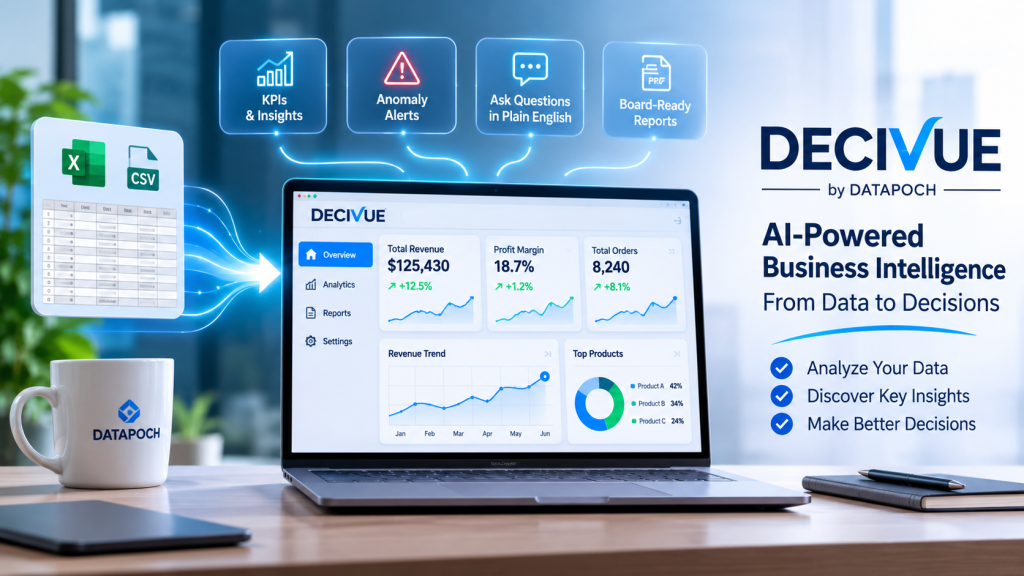
With DECIVUE, businesses can upload spreadsheets, explore KPIs, investigate anomalies, ask questions about their data, and generate professional PDF reports.
What Is AI-Powered Business Intelligence?
Traditional business intelligence focuses on collecting, organizing, and presenting business information through reports and dashboards.
AI-powered business intelligence extends these capabilities by combining data analytics, statistical analysis, anomaly detection, and natural-language interaction.
Instead of navigating multiple reports to find an answer, business users can ask questions about their data and receive understandable explanations supported by calculated results.
For example, a business owner might ask:
- Why did our expenses increase this month?
- Which product category generated the highest revenue?
- Which customers contributed most to our sales?
- Are there unusual changes in our monthly costs?
- How has our profit margin changed over time?
An intelligent analytics system can process the underlying information, calculate relevant metrics, and present the findings in a format that business users can understand.
Why Traditional Reporting Is No Longer Enough
Traditional reporting remains useful, but it often has limitations.
1. Reporting takes too much manual effort
Employees frequently spend hours exporting spreadsheets, preparing formulas, organizing information, and generating recurring reports.
2. Important patterns remain hidden
A standard report may show revenue declining without explaining which products, regions, or customer segments contributed to the change.
3. Data is difficult to access
Business information is often distributed across accounting software, CRM platforms, spreadsheets, and other applications.
4. Business users depend on technical expertise
Extracting meaningful insights may require SQL knowledge, data analysts, or specialized business intelligence tools.
5. Reports describe the past without explaining the underlying changes
Historical numbers are useful, but decision-makers also need to understand anomalies, variations, and emerging trends.
AI-powered analytics helps reduce these barriers by making analysis more accessible.
Five Capabilities of Modern AI Analytics
1. Automated Data Analysis
Modern analytics platforms can process structured datasets and identify relevant columns, metrics, categories, and time periods.
For example, when a business uploads a sales spreadsheet, an analytics system can identify revenue, dates, products, and customer-related information.
This reduces the amount of manual preparation required before analysis begins.
2. KPI Monitoring and Performance Tracking
Key Performance Indicators help businesses measure whether their operations are achieving defined objectives.
Analytics systems can calculate and monitor metrics such as:
- Total revenue
- Operating expenses
- Profit margins
- Average transaction value
- Sales growth
- Customer activity
- Product performance
Centralized KPI monitoring gives decision-makers a clearer picture of business performance.
3. Anomaly Detection
Not every unusual change is immediately visible in a spreadsheet.
Anomaly detection helps identify values or patterns that differ significantly from expected behavior.
Examples include:
- Unexpected increases in operating expenses
- Unusual revenue declines
- Changes in transaction volumes
- Abnormal product returns
- Unexpected monthly cost variations
These alerts help businesses investigate potential problems earlier.
4. Natural-Language Data Analysis
One of the most useful developments in AI analytics is the ability to interact with business information using ordinary language.
Instead of writing SQL queries or manually configuring complex reports, users can ask questions about their datasets.
An AI analyst can explain calculated results, summarize trends, and identify the data fields supporting its conclusions.
This makes business intelligence more accessible to people who do not have technical backgrounds.
5. Automated Business Reporting
Preparing reports for management meetings, financial reviews, and operational discussions can consume valuable time.
AI analytics platforms can help generate structured summaries and downloadable reports that communicate important findings.
A well-designed report can bring together:
- Performance indicators
- Revenue and expense trends
- Anomaly findings
- Category breakdowns
- Analytical explanations
- Important observations
The objective is to make business information easier to communicate and act upon.
How DECIVUE Makes Business Analytics More Accessible
At DataPoch, we developed DECIVUE to address a practical problem: businesses have valuable information in spreadsheets, but extracting meaningful insights often requires too much time and technical effort.
DECIVUE is an AI-powered business intelligence analyst that helps users turn CSV and Excel files into understandable business insights.
Rather than requiring a complex BI implementation, users can upload a supported spreadsheet and begin exploring their data.
DECIVUE provides several analytical capabilities:
Automated KPI Analysis
DECIVUE identifies relevant business metrics and calculates important performance indicators from uploaded datasets.
Anomaly Alerts
The platform helps identify unusual values and patterns that may require further investigation.
Plain-English Answers
Users can ask questions about their uploaded data and receive explanations based on calculated analytical results.
Source-Linked Insights
Analytical figures are calculated by the analytics engine, and results identify the source columns used. This helps users understand where the numbers originate.
Board-Ready PDF Reports
Users can generate downloadable reports that organize important findings for management and business discussions.
Simplified Data Analysis
DECIVUE supports CSV and Excel uploads, making it easier to begin analyzing existing business spreadsheets without first implementing a large business intelligence infrastructure.
Explore DECIVUE: https://decivue.datapoch.com/
Who Can Benefit from AI-Powered Analytics?
AI-powered business intelligence can support organizations across different industries.
Finance Teams
Analyze expenses, revenue trends, financial variations, and unusual transactions.
Sales and Revenue Operations
Monitor sales performance, customer activity, revenue trends, and pipeline-related metrics.
Retail and E-commerce
Understand product performance, sales patterns, category trends, and changes in customer demand.
Operations Teams
Monitor operational indicators, identify unusual performance changes, and improve reporting processes.
Consultants and Agencies
Analyze client datasets, prepare management reports, and communicate findings more efficiently.
Making Business Intelligence More Practical
Implementing advanced analytics does not always require a large technology transformation.
Businesses can start with information they already have.
A structured spreadsheet containing financial, sales, operational, or customer information can provide a useful starting point for understanding business performance.
The important steps are to organize the data, calculate reliable metrics, identify meaningful patterns, and communicate the results clearly.
As analytical requirements grow, organizations can expand toward integrated dashboards, automated data pipelines, predictive models, and custom analytics applications.
The right approach depends on the business problem, data availability, and expected outcomes.
The Future of Business Intelligence
Business intelligence is moving beyond static dashboards and manually prepared reports.
AI-assisted analysis, automated reporting, anomaly detection, and natural-language interaction are making analytical capabilities more accessible to everyday business users.
However, technology alone does not guarantee better decisions. Reliable calculations, transparent data sources, appropriate validation, and clear explanations remain essential.
At DataPoch, our focus is on developing practical AI and analytics solutions that connect business information with meaningful decisions.
Whether you want to understand financial performance, monitor sales trends, identify unusual business activity, or simplify spreadsheet analysis, the first step is making your data easier to understand.
Ready to Discover More in Your Business Data?
Meet DECIVUE, your AI-powered business intelligence analyst.
Upload a spreadsheet, explore your KPIs, investigate anomalies, ask questions, and generate reports.
Start free: https://decivue.datapoch.com/auth/register
Learn more: https://decivue.datapoch.com/
DECIVUE — AI Business Intelligence by DataPoch.
Want this built for your business? Datapoch builds data dashboards and AI insights for US service businesses. Book a free call to talk through your project.
Stop Losing Contractor Leads
Datapoch helps contractors in the USA and Canada capture more leads, automate follow-up, and book more appointments.
Get Free ConsultationFrequently Asked Questions
How can contractors get more leads from their website?
Contractors can improve results by adding faster response systems, clearer calls to action, instant estimate tools, AI chat, and automated follow-up.
Does this blog layout work with old posts?
Yes. Once the plugin is activated, it automatically applies the premium layout to existing and new single blog posts.
Is this plugin built for Astra Free?
Yes. It is designed to work with Astra Free and Classic Editor, but it should also work with most standard WordPress themes.


